World
Bank Rebel Wages War Against Wall Street
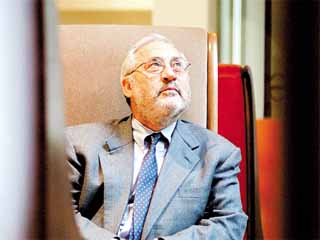
Nobel
prize-winner Joseph Stiglitz turns his back on US establishment
to fight the cause of impoverished nations being exploited
by IMF and global powers
JOSEPH
Stiglitz is a rare breed, an heretical economist who has
ruffled the self-satisfied global establishment that once
fed him.
When
I met him in the fashionable surroundings of One Aldwych
last week, Stiglitz warned that current fears about the
reliability of corporate accounts could easily extend
to the national UK governmental level.
Stiglitz
says: 'We've been seeing the same lack of ethics in accounting
in the Bush administration on the public side. Misleading
accounting practices are pervasive and were very extensively
engaged in by the Bush administration in the context of
the last tax cut.'
In
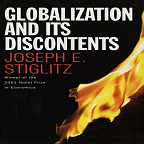
his book, Globalization And Its Discontents, the Nobel
laureate and former World Bank chief economist goes beyond
attacking Dubya. He declares war on the entire Washington
financial and economics establishment, of which he was
once a part, over its failure to reduce disparities between
rich and poor countries.
Stiglitz
accuses the agents of US economic policy -- the US Treasury,
the International Monetary Fund and the World Bank --
of having subverted the process of globalisation for many
years, turning it into a one-way street which benefits
only the developed world.
'I
tried in my book to describe the lack of intellectual
coherence in the World Bank,' said Stiglitz. 'Even Milton
Freidman would reject most of what they are doing.'
With
capitalism at what he terms a 'crossroads', just as it
was during the Great Depression of the 1930s, and with
the IMF weakened after its maladroit handling of the Asian,
Russian and Argentine crises, the neo-Keynesian Stiglitz
believes we have a wonderful opportunity to encourage
the IMF and World Bank to mend their ways.
Rather
than continuing to use the IMF as a cudgel to push discredited
Reaganite/Thatcherite free market policies on troubled
emerging markets, he believes the IMF and World Bank must
become less ideologically driven and ensure their prescriptions
are no longer mere blood-letting.
In
common with Will Hutton, author of The World We're In,
Stiglitz believes the developed world must also set an
example by dismantling its own trade barriers -- such
as farm tariffs and the Common Agricultural Policy --
before it brutalises poorer countries into opening up
their own markets to Western goods.
He
accuses the IMF of gross hypocrisy, especially when it
claims not to believe in subsidies yet spends 'billions
of dollars in bail-outs -- which are nothing more than
subsidies for foreign exchange markets'.
Stiglitz
also wants to ensure IMF loans no longer come with strings
attached. At the moment, they are loaded with conditions
which almost invariably undermine the recipient countries'
'ownership' of the prescribed reforms -- and hence their
willingness to carry them out.
He
points out that at times of crisis the IMF's medicine
usually has the unfortunate side-effect of worsening the
country's affliction, crippling its economy for years
to come and causing lasting social problems.
He
professes admiration for countries such as China, Malaysia
and Botswana which have seen off the IMF. 'China and Malaysia
both saw maintaining social stability was of first order
importance. They protected their own citizens more than
the democracies did.'
Stiglitz
adds: 'IMF decisions were made on the basis of a curious
blend of ideology and bad economics, dogma that sometimes
seemed to be thinly veiled special interests.'
The
most shocking thing, he says, is that the real winners
are advanced economies such as the US and UK -- and investment
banks on Wall Street. He suggests such firms earn millions
of dollars by shifting capital in and out of countries
which are prone after succumbing to the IMF treatment.
The
most controversial passage in his book alludes to conflicts
of interest in Washington which allow 'masters of the
Universe' from big banks to shift effortlessly in and
out of the IMF or even US Treasury.
Robert
Rubin, for example, went from Goldman Sachs, to the Treasury
Secretary and left to become chairman of Citigroup, the
world's largest bank.
Stiglitz
writes: 'Stan Fischer, the deputy managing director [of
the IMF] went directly from the IMF to become a vice-chairman
at Citibank. One could ask: Was Fischer being richly rewarded
for having faithfully executed what he was told to do?'
This
was like a red rag to a bull for the IMF, which rose to
the bait last week. Ken Rogoff, the former Harvard University
professor and chess grand master who recently became economic
counsellor and research director at the IMF, responded
with a furious tirade against Stiglitz, which is published
on the IMF's website.
Rogoff
said: 'You slander Fischer, implying Citibank may have
dangled a job offer in front of him in return for his
co-operation in debt renegotiations. Fischer is well known
to be a person of unimpeachable integrity. Of all the
false inferences and innuendos in this book, this is the
most outrageous. I'd suggest you should pull this book
off the shelves until this slander is corrected.'
Rogoff
also accused Stiglitz of 'carelessly slandering' IMF staff,
'ignominiously sabotaging' interest defence policies,
and of fuelling the panic during the Asian crisis 'by
undermining confidence in the very institutions you were
working for'.
Yet
Stiglitz showed no signs of toning down his critiques
when I met him last week, after emerging unscathed from
a BBC studio in which he was confronted by Jeremy Paxman
and Economist editor Bill Emmott on Radio 4's Start the
Week.
Stiglitz
resigned in summer 1999 as the World Bank's chief economist
to become a professor of economics and finance at New
York's Columbia University precisely because he wanted
the freedom to speak out about such things. He isn't likely
to allow himself to be muzzled now --especially since
post Seattle and Genoa he believes the battle is already
half won.
According
to Stiglitz, capital market liberalisation was a crazy
policy to inflict on East Asia during the economic crisis
of 1997-98. 'You can't argue that more capital was needed
in East Asia because they were saving 30-35% of their
GDP. They were having a hard time investing their own
savings.
'So
why was capital market liberalisation pushed on them?
Because it benefited Wall Street.'
Born
in 1943 in Gary, Indiana, Stiglitz became a Yale professor
at the age of 26. In 1993 joined Bill Clinton's team of
economic advisers, and was eager to play his part in creating
a more equitable and balanced America. He has since aimed
at ensuring globalisation is handled in ways that are
more palatable to the developing world. If this could
not be achieved from inside, he wants to fight the same
fight from without.
He
says: 'One point that I make in the book is that all the
activities of the IMF have been in developing countries
and yet it's still run by G7 and particularly by the United
States. The US Treasury, always the most conservative
American institution, has a disproportionate voice.'
Stiglitz
mistrusts the current system whereby the World Bank is
always headed by an American with the IMF always run by
a European, with an American as IMF number two. 'It's
a global institution and it should be the best qualified
person in the world.'
When
the German Horst Kohler replaced Michel Camdessus as IMF
head, Stiglitz notes the ridiculousness of the situation.
'Despite the fact that all the IMF's work has been in
the developing world since 1976, nobody said the next
head should be from a developing country.'
He
questions the appointment of Anne Krueger, a Bush nominee,
as IMF number two. 'People all around the world were saying
this institution needs to open up to new ideas. And so
who do they appoint? Somebody who was a throwback to the
Reagan era: it was really quite astounding.'
But
does Stiglitz detect any glimmers of hope? And is there
any chance that the people at the World Bank and IMF are
going to listen to his impassioned pleas for change?
'I'm
very hopeful. There's been an enormous amount of change,
especially at the World Bank in the last eight years.
Many of the issues I raised six years ago have already
resulted in change. They are now talking about the importance
of [national] bankruptcy. I started talking about reducing
the burden of conditionality they are now talking about
that.'
'There's
been some movement at the IMF. But there's still a long,
long way to go.'
Many
citizens of the third world will be hoping that Stiglitz
is not burned at the stake before we finally get there.
Globalization
And Its Discontents (Penguin £16.99) is out now
Source:
http://www.sundayherald.com/25987
|





